

































Across Europe’s multimodal freight terminals, rail operations remain a critical bottleneck. Shunting, marshalling, and railcar handling are complex, labour-intensive, and highly sensitive to disruption. Even small inefficiencies can cascade across ports, rail corridors, and road networks, increasing congestion, emissions, and costs.
Within the AutoMoTIF project, this challenge is addressed through automated shunting as a service, with Mosaic Factor leading the development of the simulation framework.
From operational bottleneck to coordinated rail operations
Shunting plays a central role in intermodal terminals, linking maritime cargo flows with inland distribution. However, traditional shunting operations are often reactive, fragmented across systems, labour-intensive, and energy-inefficient.
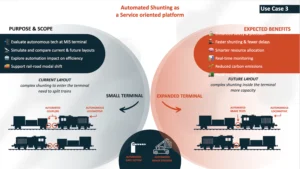
Shunting as a service reimagines these operations as a digitally orchestrated service platform where autonomous locomotives, yard resources, and scheduling systems operate as an integrated ecosystem. The aim is not simply automation, but service optimisation.
Simulation driving the transformation
Mosaic Factor’s advanced simulation environment replicates the operational complexity of rail terminals, including train movements, wagon marshalling, yard capacity constraints, container handling cycles, resource allocation, and disruption scenarios.
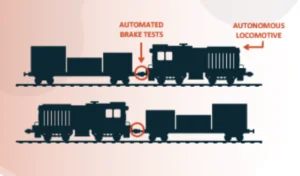
Autonomous shunting locomotives are modelled as intelligent agents that dynamically respond to congestion, schedule changes, and infrastructure constraints.
Through scenario modelling, the simulations evaluate:
- Reduced shunting time
- Faster wagon turnaround
- Lower idle and waiting times
- Optimised energy consumption
- Increased yard throughput
- Improved safety and lower operational costs
This data-driven approach ensures automation concepts are validated before real-world deployment.
Shunting as a Service Platform
Shunting as a service introduces a shift in how rail yard operations are structured. Instead of a fixed internal activity, shunting is modelled as a service-oriented platform where capacity is dynamically allocated, operations are digitally coordinated, and performance is continuously monitored.
This approach supports greater interoperability between terminal operators, rail infrastructure managers, logistics providers, and port authorities, while enabling integration with other automated processes within AutoMoTIF.
Supporting Smarter Rail Terminals
To ensure realistic outcomes, Mosaic Factor calibrates simulations using historical operational data, planning inputs, and stress-test scenarios that reflect peak demand and future growth.
The resulting models provide decision-support tools for infrastructure investment, automation strategies, business models, and regulatory alignment, helping reduce risk and accelerate deployment.
Strengthening Europe’s Rail Freight Network
By improving rail efficiency, automated shunting supports broader logistics goals, including:
- Modal shift from road to rail
- Reduced terminal congestion
- Lower emissions
- Safer working conditions
- More reliable logistics operations
Through simulation-driven validation, Mosaic Factor demonstrates how automated shunting can increase throughput, reduce delays, optimise energy use, and enhance safety.
Automated shunting as a service-oriented platform represents more than a technological upgrade. It introduces a new operational model that strengthens the role of rail in Europe’s transport system while supporting a more efficient and sustainable logistics network.
→ Check our Digital Twins solution