






























Our team participated in this year’s Software-Defined Vehicles Conference in Berlin, which brought together leading voices in automotive innovation, with a strong focus on how Artificial Intelligence (AI) is reshaping the industry. Across multiple sessions, experts showcased how AI is driving advancements in safety, personalisation, and development processes.
Key sessions featuring AI
Agentic AI in the Car: From Orchestration to Agentic Personalisation
- Speaker: Dogukan Sonmez, Project Lead Machine Learning Platform, BMW AG
- Focus: generative AI applications beyond text, handling 3D models, sensor streams, and domain-specific data.
- Highlight: explored multi-agent system architectures and orchestration techniques, showing how agentic AI can improve efficiency, adaptability, and decision-making in SDVs.
This session revealed groundbreaking approaches to embedding AI into the very core of vehicle intelligence, making it one of the most forward-looking talks of the event.
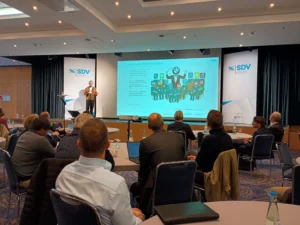
Scalable Function Deployment for SDV
- Speaker: Michael Niklas-Höret, AUMOVIO
- Focus: the ongoing (R)evolution of E/E architectures in vehicles, from decentralised domain-centric to Server Zone and Central Compute/Zero Edge, and the resulting challenge in deploying functions across these diverse architectures.
- Highlight: introduction of a new function development pattern designed to enable the re-use of functions across the three main architectures (and their hybrids), aiming to ease OEM migration to new E/E platforms and increase re-use across vehicle lines.
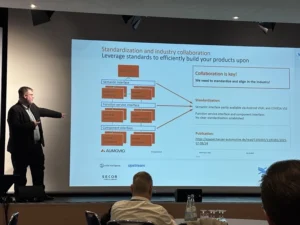
From Code to Car – Accelerating SDV Integration with Shift-Left and CI/CT
- Speaker: Felix Pretscheck, Bosch
- Focus: how the introduction of next-generation Compute ECUs, combined with a shift-left approach, virtualisation, and a modular CI/CT (Continuous Integration/Continuous Testing) framework, is transforming and accelerating the software and system integration process for Software-Defined Vehicles (SDV).
- Highlight: showcasing key methodologies and architectural enablers that streamline integration and validation, leading to improved software quality, faster integration cycles, and more agile, scalable, and production-ready complex automotive systems.
Coding for Cars: AI in the Driver’s Seat
- Speaker: Mikhail Vink, VP of Business Development, JetBrains
- Focus: the role of AI-driven development in regulated industries, ensuring the quality and security of AI-generated code, and integrating AI into DevOps.
- Highlight: demonstrated how AI can streamline coding processes while maintaining compliance and safety standards.
Between Research and Current Development in ADAS
- Speaker: Khaled Alomari, Manager Connected Vehicles, MHP (A Porsche Company)
- Focus: bridging cutting-edge research with real-world Advanced Driver Assistance Systems (ADAS) development.
- Highlight: emphasized collaboration between academia, industry, and regulators to accelerate AI-powered ADAS adoption.
Khaled’s insights underscored the critical role of AI in enhancing safety and efficiency, making this session a must-attend for anyone interested in the future of connected vehicles.
Mastering Complexity with Digital Twins
- Speaker: Ignacio Izaguirre, VP of Product, Concentrio AG
- Focus: leveraging digital twins at the signal level for software management.
- Highlight: showed how applying AI to dependency nets can identify anomalies and vulnerabilities, improving OTA updates and system reliability.
AI-Driven Autonomy in SDVs
- Speaker: Shashank Pathak, Product Management, ZF Friedrichshafen AG
- Focus: how AI enables perception, planning, and control in autonomous SDVs.
- Highlight: discussed challenges of deploying AI on automotive hardware and strategies for safe, scalable autonomy.
Workshops and world café sessions
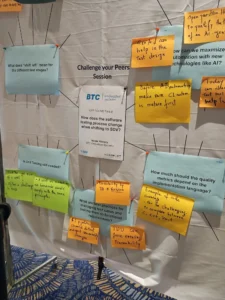
The workshop sessions “Challenge Your Peers” brought attendees together in small, moderated roundtables where we debated pressing industry questions using collective intelligence and mind maps. Topics ranged from how software testing evolves under SDV architectures, the role of AI in automotive development, and the future of ASPICE compliance, to redefining in-car experiences through advanced HMI and exploring AI-driven autonomy.
Each workshop encouraged participants to share experiences, challenge assumptions, and co-create solution concepts. Similarly, the World Café format provided a dynamic environment for peer learning, cross-industry networking, and the generation of actionable insights that complemented the more formal presentations and case studies.
Our takeouts
The conference highlighted that AI is no longer a peripheral tool but a central pillar in the evolution of software-defined vehicles. From agentic personalisation at BMW to AI-powered ADAS at MHP, the sessions demonstrated how intelligence is being woven into every layer of automotive innovation.
These talks not only showcased current applications but also pointed toward a future where vehicles are adaptive, intelligent, and deeply connected.