

































At this year’s RTR Conference, Stefano Persi, CEO, presented Mosaic Factor’s latest advances in software-defined electric vehicles (EVs) through the Twin-Loop project. His session focused on the transformative role of digital twins and TwinOps methodology in optimising energy consumption, safety, and overall EV performance across the vehicle lifecycle.
Driving efficiency and innovation with digital twins
Persi highlighted the MyEV Digital Twin, a two-layer architecture with a full off-board version for simulations and a lighter in-vehicle version, fully connected and interoperable with AI applications to enable continuous updates and optimisation.
This design enables continuous updates and interoperability with advanced AI applications, ensuring that software-defined EV functions can be optimised for energy efficiency, safety, and driver experience throughout the vehicle’s lifecycle.


TwinOps Methodology: Continuous Optimisation
At the heart of Twin-Loop is the TwinOps concept, which merges:
- Model-based engineering (MBE) principles
- DevOps practices
- Digital twin continuous integration
This methodology allows digital twins to remain synchronised with evolving vehicle designs, supporting efficient design, validation, and operational decision-making. TwinOps also leverages vehicle and fleet data to enhance energy optimisation, safety, and system integrity without interfering with core EV functions.
Energy, safety and sustainability
Energy efficiency was a key focus of the presentation. Persi outlined how optimised in-vehicle algorithms and compressed data transmission can reduce energy usage while maintaining high performance. He also highlighted how TwinOps integrates environmental modeling, supporting lifecycle emission reduction and the transition toward software-defined vehicles (SDVs).
Safety and cybersecurity remain central to the framework: digital twins and apps are designed to operate behind core systems, with tools such as CyberCar, OFSCE, ModVV, and ZTBCar providing protection against individual vehicle attacks, fleet-level intrusions, and in-vehicle system violations.
Fostering collaboration and European competitiveness
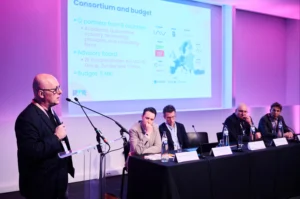
The Twin-Loop consortium brings together 12 partners from 8 countries, spanning academia, automotive manufacturers, technology providers, and consulting firms. Advisory board members include ZF Friedrichshafen AG, Volvo Group, Zunder, and Traton, and the project is supported by a €5 million budget.
By developing an open framework for MyEV Digital Twins and a suite of connected applications, Twin-Loop aims to accelerate innovation, reduce development time, and strengthen European automotive competitiveness. The framework provides reusable modules, development guidelines, and shared services, simplifying complex digital system development.
Looking ahead
The presentation highlighted how TwinOps and MyEV Digital Twins are driving a new era of smarter, safer, and more sustainable electric vehicles. By leveraging continuous improvement and fleet-level insights, these tools enhance energy efficiency, driver experience, and overall system resilience. Through Twin-Loop, the project is helping shape the future of software-defined vehicles and driving the European automotive industry toward the next generation of mobility.