

































Three days of discussions at AI Congress 2026 in Barcelona reinforced a message that resonates strongly with us at Mosaic Factor: building more powerful AI models is no longer enough.
As artificial intelligence moves from experimentation into everyday business operations, the real challenge is turning technological capabilities into solutions that create measurable value. Across sessions on AI agents, data governance, synthetic data, machine learning and enterprise adoption, a common theme emerged. Organisations are no longer asking what AI can do. They are asking how to deploy AI responsibly, scale it efficiently, and ensure it delivers meaningful outcomes.
At Mosaic Factor, many of the themes discussed at the Congress closely reflect the challenges we address in our own projects, from trustworthy AI and advanced analytics to data governance, digital twins and AI-powered decision-support systems.
These were some of the key insights we took away from the event.
1. Successful AI adoption starts with the problem, not the technology
AI agents are evolving rapidly, creating new opportunities to automate workflows, support complex tasks and improve decision-making. But with new models, platforms and tools appearing every week, organisations face a fundamental question:
Where should we start?
One of the most practical messages from the Congress was surprisingly simple: start with the problem. Before selecting a model or adopting a platform, organisations need to understand:
- Who will use the solution?
- What challenge are they trying to solve?
- Which part of the process needs improvement?
- How will success be measured?
Context is often the deciding factor between a successful AI initiative and one that struggles to deliver value. AI systems require relevant information about objectives, users, constraints and operating environments to generate useful outcomes.
Just as importantly, AI must fit existing workflows and business realities. Effective implementation is rarely about replacing people. It is about identifying where technology can augment expertise, improve efficiency and support better decisions.
For us, this reinforces an important principle: meaningful AI innovation starts with a clear business need, not with the technology itself.
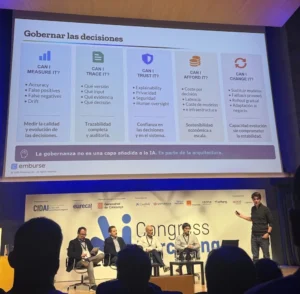
2. Trustworthy AI depends on Trustworthy Data
Data governance emerged as one of the most consistent themes throughout the Congress.
As AI systems become more capable, their effectiveness increasingly depends on the quality, accessibility and governance of the data that supports them. Several sessions focused on European data spaces and the growing importance of creating trusted mechanisms for data sharing and collaboration.
Examples such as the UPC Data Space initiative demonstrated how organisations can share and reuse information while maintaining clear rules around access, ownership, and usage.
Applications discussed during the event included sectors such as:
- Agriculture
- Energy
- Mobility
- Construction
In one example, geospatial and environmental information was integrated into a common framework, making it easier for AI systems to assess agricultural conditions, evaluate risks, and support investment decisions.
The broader lesson extends well beyond any single sector. Connecting datasets is only part of the challenge. Organisations must also ensure that information remains meaningful within its intended context and that governance mechanisms clearly define how that information can be used.
This discussion is closely linked to the concept of digital sovereignty and to the evolving European regulatory landscape, including the GDPR, Data Governance Act and EU AI Act.
For businesses, governance should not be viewed solely as a compliance requirement. It is a foundation for trust, collaboration and responsible AI adoption.
3. Synthetic data can help unlock new opportunities
Many AI projects face a common obstacle: the data required to develop, test or validate a solution may be incomplete, fragmented or unavailable.
Synthetic data offers one potential way to address this challenge.
One particularly interesting example presented during the Congress focused on mobility planning in rural environments. Unlike large urban areas, rural communities often have dispersed populations and limited transport options. This makes collecting comprehensive mobility data difficult while simultaneously making efficient transport planning more important.
The Nemi mobility use case demonstrated how AI-driven simulations can generate synthetic mobility demand and origin-destination matrices by combining information such as:
- Areas of interest
- Potential travel origins and destinations
- Temporal patterns and constraints
These simulated datasets allow planners to evaluate potential transport services and explore mobility patterns even when complete real-world data is unavailable.
The example highlighted an important point about synthetic data. Its value depends on how and where it is used.
Synthetic data can be highly effective for prototyping, simulation and pre-production testing. However, organisations must understand its limitations and carefully evaluate whether additional validation is required before deploying solutions in operational environments. As with any AI system, success depends on choosing the right tool for the right purpose.
4. AI must be scalable, efficient and sustainable
Another recurring message throughout the Congress was that technical performance alone is not enough. A successful proof of concept does not automatically become a successful production system. As AI solutions scale, organisations face new challenges related to infrastructure, operational complexity, costs and resource consumption.
Three dimensions of efficiency appeared repeatedly throughout the discussions:
- Cost Efficiency. Understanding the financial implications of deploying, operating and scaling AI systems.
- Resource Efficiency. Selecting the right models and architectures for each use case instead of defaulting to the largest or most complex solution.
- Environmental Efficiency. Considering the energy and resource requirements associated with AI deployment.
Operational efficiency is equally important. Organisations must determine:
- Which tasks should be automated.
- Where human oversight remains necessary.
- How systems should handle exceptions and unexpected situations.
- How workflows should be structured to balance performance, governance and cost.
This distinction is important. Deploying AI is not the objective, creating solutions that continue to deliver measurable business value over time is.
5. Governance, security and accountability cannot be an afterthought
As AI becomes embedded within increasingly important business processes, governance and security become critical enablers of sustainable adoption. Several discussions focused on the fact that AI systems are not static.
- Models evolve.
- Configurations change.
- Prompts are updated.
- New data becomes available.
As a result, performance, compliance and risk cannot be evaluated once and then forgotten.
Organisations need structured processes to:
- Monitor system behaviour.
- Document decisions.
- Assess risks continuously.
- Respond to emerging issues.
- Demonstrate compliance when required.
These requirements become particularly important in regulated industries, where organisations may need to explain how AI systems operate and provide evidence that appropriate controls are in place.
The discussion also highlighted the importance of the people working alongside AI.
- Providing employees with access to AI tools does not automatically translate into successful adoption.
- Training, change management, internal policies and ongoing support all play essential roles.
- Trustworthy AI is therefore not a one-time achievement. It requires continuous attention to governance, security, accountability and human oversight.
6. Beyond Generative AI: traditional Machine Learning still delivers value
While generative AI and AI agents dominated many conversations, the Congress also provided an important reminder: traditional machine learning continues to solve real business problems.
- Many use cases involving prediction, classification, anomaly detection and structured data analysis remain highly effective without requiring large language models. A
- t the same time, multimodal AI is creating new opportunities by combining text, images and other forms of information into unified systems. Both approaches have value.
- The important lesson is that technology choices should be driven by the problem being solved. The newest model is not automatically the most appropriate one.
- Successful AI strategies require a clear understanding of available technologies, business objectives and operational constraints.
Innovation should ultimately be measured by the value it creates, not by the sophistication of the technology itself.
The next phase of AI adoption
Looking across the discussions at AI Congress 2026, our main conclusion may be that the future of AI will not be defined solely by larger models, more parameters or new capabilities.
It will be shaped by an organisation’s ability to:
- Identify meaningful business problems.
- Build on trusted and well-governed data.
- Deploy AI efficiently and sustainably.
- Maintain security, accountability and human oversight.
- Generate measurable outcomes beyond the proof-of-concept stage.
These challenges are deeply interconnected. Solving them requires more than technical expertise. It requires collaboration between domain experts, business stakeholders and AI specialists to ensure that solutions are not only technically capable but also useful, trustworthy and aligned with real-world needs.
At Mosaic Factor, we believe that successful AI adoption happens when technological capabilities are combined with strong governance, high-quality data and a clear understanding of the people who will ultimately use the solution.
That was perhaps the most valuable lesson from AI Congress 2026, and one that continues to guide our work across healthcare, industry, mobility and emerging domains such as software-defined vehicles.