































Artificial intelligence is rapidly transforming automotive manufacturing, from predictive maintenance and energy optimisation to digital twins and quality control. In AutoRevista’s September issue (page 64), Mosaic Factor was featured alongside Overstand Intelligence and GFT to discuss how AI is already delivering measurable value on the automotive plant floor.
In this article, we share the key insights from the report and expand on areas that are becoming increasingly important for automotive OEMs and suppliers: explainable AI, trusted decision-making, industrial digital twins, and the evolution toward the Software Defined Vehicle (SDV).
1. Focus AI investments on high-impact manufacturing processes
AI delivers the strongest return on investment in manufacturing environments where operational complexity, equipment downtime and quality issues generate significant costs.
As we told AutoRevista:
“The greatest returns are usually found in areas characterised by high operational complexity, large data volumes, and significant costs associated with downtime, rework, or energy consumption”.
In practice, that means:
- predictive maintenance on critical equipment
- real-time monitoring to find bottlenecks
- tuning process parameters
- and quality control based on data from sensors, MES, SCADA and PLC systems.
Digital twins tie these together. Before moving a line, changing a logistics flow or adding capacity, a plant can test the change virtually, “reducing risk and accelerating decision-making”.
2. Predictive AI and Generative AI solve different manufacturing challenges
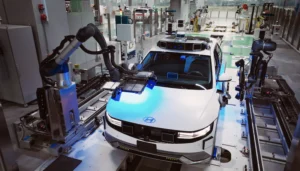
In automotive manufacturing, predictive AI is commonly used for predictive maintenance, anomaly detection and process optimisation, while Generative AI supports knowledge management, engineering documentation and workforce assistance.
Predictive AI and Generative AI are often lumped together, but on the shop floor they solve different problems. Predictive models are the more mature tool, used to anticipate failures, model equipment behaviour and plan maintenance. Generative AI is newer and helps people more than machines. It makes technical documentation and expert know-how accessible to production, engineering, maintenance and quality teams.
That second use is becoming urgent. As we pointed out in the interview:
“Knowledge transfer and the availability of specialized personnel have become strategic challenges for many plants”.
3. AI-powered energy optimisation is becoming a competitive advantage
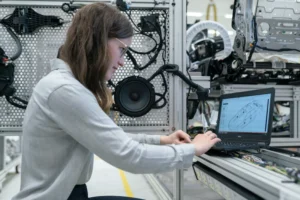
Energy-intensive operations such as paint shops, ovens, compressed air systems and HVAC infrastructure are increasingly being optimised through machine learning models and digital twin technologies.
“This enables a shift from reactive energy management to continuous, data-driven optimisation, an approach that also aligns with the sustainability and emissions-reduction goals currently being set by the automotive industry”. Said our CTO.
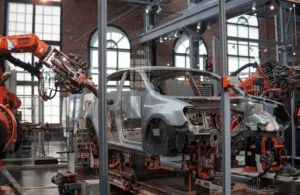
4. Explainable AI keeps humans in control of critical manufacturing decisions
As AI systems become more deeply embedded in production processes, explainable AI (XAI) is becoming essential for quality assurance, regulatory compliance and operational trust.
Manufacturing and quality teams need to understand why an AI system recommends a particular action, especially when decisions affect safety, production continuity or product quality.
All three companies in the report agreed on this point. AI vision can now handle most repetitive, high-volume inspection very well. For the most critical components, though, we believe the best setup combines AI, vision systems and human oversight.
There’s a reason behind this that the printed version didn’t include. In industrial settings, decisions have to be auditable and understandable for the production and quality teams who answer for them. That’s why we focus on explainable, trustworthy AI, and why our tagline is AI you can trust.

Our view is that AI should make teams more capable, not replace them, helping them decide faster, with better evidence and less uncertainty.
5. The Software-defined vehicle is reshaping automotive manufacturing
The rise of the Software-Defined Vehicle (SDV) is changing not only vehicle development but also how automotive plants operate.
Modern vehicles increasingly rely on software, sensors, connectivity and continuous updates throughout their lifecycle. As a result, manufacturers need production environments that can adapt quickly to product changes, validate software-intensive systems and maintain end-to-end traceability.
AI, digital twins and advanced analytics play a key role in supporting this transition. They enable manufacturers to simulate production scenarios, monitor quality in real time, and accelerate decision-making across engineering and plant operations.
At Mosaic Factor, we believe that the convergence of AI, industrial digital twins and explainable decision-support systems will be fundamental for the next generation of Software-defined Vehicle manufacturing.
Or, as we put it to AutoRevista:
“In our view, the future lies in increasing integration between the physical and digital worlds, with AI acting as the backbone of the entire value chain”.
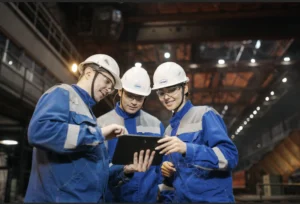
AI in automotive manufacturing requires more than automation
The automotive industry is moving beyond isolated AI pilots and toward data-driven operations where predictive maintenance, digital twins, energy optimisation, and explainable AI work together to improve productivity and resilience.
For automotive OEMs and suppliers, the challenge is no longer whether to adopt AI but where to generate value first and how to scale solutions safely and transparently.
At Mosaic Factor, we help industrial organisations deploy trustworthy AI, machine learning, digital twin, and explainable AI solutions that deliver measurable impact while keeping people at the center of decision-making. As automotive manufacturing evolves toward the Software-Defined Vehicle era, trusted and explainable industrial AI will become a critical competitive differentiator.
Thank you to AutoRevista and Irene Díaz for including us, and to Overstand Intelligence and GFT for a great discussion.
📖 Read the full report in AutoRevista No. 2,414 (September 2026), pp. 64–69.
🎥 Watch our corporate video: