

































Brussels, 17 November 2026 – One year after the launch of the European Commission’s Apply AI Strategy, the Apply AI Summit brought together policymakers, industry leaders, startups, researchers and public-sector innovators to assess Europe’s progress and define the next phase of AI adoption across the continent.
Across discussions spanning healthcare, manufacturing, mobility, public administration, cybersecurity and AI safety, one message stood out consistently: Europe is moving beyond the race to build AI models and focusing instead on deploying trustworthy AI systems that can create tangible value in real-world environments.
For organisations operating in regulated and high-impact sectors, the summit confirmed a fundamental shift. Competitive advantage will no longer be determined solely by access to advanced models, but by the ability to deploy AI safely, govern it effectively and earn the trust of users, customers and regulators.
From AI innovation to AI deployment
Throughout the day, European Commission leaders emphasised that the objective of the Apply AI Strategy is not simply to support AI research but to accelerate adoption across strategic sectors while strengthening Europe’s technological sovereignty.
The focus has clearly evolved from developing AI capabilities to operationalising them. Successful organisations will be those capable of transforming AI from experimental initiatives into scalable products, services and operational processes that deliver measurable outcomes.
This transition requires more than technology. Speakers repeatedly highlighted the importance of governance frameworks, workforce readiness, regulatory certainty and industrial ecosystems capable of supporting AI at scale.
Healthcare: trust becomes the gateway to adoption
Among the most relevant sessions for the healthcare community was “Scaling AI in Healthcare: From Prevention to Clinical Practice”.
The discussion reflected the growing maturity of healthcare AI across Europe. The debate is no longer centred on whether AI can support clinical decision-making, imaging analysis or patient monitoring. The challenge today is how to integrate these capabilities safely and effectively into everyday clinical practice.
Several priorities emerged:
- Embedding AI into real clinical workflows rather than creating isolated pilot projects.
- Supporting preventive and predictive healthcare models.
- Ensuring clinicians understand and trust AI-supported recommendations.
- Demonstrating safety, robustness and effectiveness before deployment at scale.
- Establishing continuous monitoring and governance mechanisms.
The session reinforced a reality increasingly recognised across the healthcare sector: technical performance alone does not guarantee adoption. Explainability, transparency and accountability are becoming essential requirements for deploying AI in clinical environments.
This aligns closely with the objectives of the European Health Data Space (EHDS), which aims to create a trusted framework for the secure use and reuse of health data across Europe, enabling the development of more robust, explainable and clinically validated AI solutions.
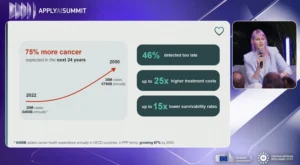
For organisations developing AI-based healthcare solutions, this represents a significant opportunity. As adoption expands, demand is increasing for technologies that combine advanced analytics with explainable AI, risk management and trustworthy decision support.
The AI Act: from compliance challenge to competitive advantage
One of the summit’s most important discussions explored the relationship between innovation and regulation through the lens of the AI Act.
Contrary to the often-cited assumption that regulation slows innovation, speakers argued that regulatory certainty can actually accelerate deployment by creating trust among stakeholders and reducing adoption barriers.
In sectors such as healthcare, mobility, critical infrastructures and the public sector, organisations that establish governance processes early are likely to gain advantages as procurement requirements, conformity assessments and trust expectations become more demanding.
The message was clear: compliance should not be viewed as a final checkpoint before deployment. It is increasingly becoming part of the product strategy itself.
AI safety moves from Research to operational reality
A recurring theme throughout the summit was the growing importance of AI Safety.
The session dedicated to evaluating advanced AI models highlighted a major evolution in the field. The focus is shifting from model development to systematic assessment of reliability, robustness and behavioural risks.
This trend is reflected in the growing international focus on AI evaluation and safety. Organisations such as the OECD and the emerging network of national AI Safety Institutes are promoting rigorous approaches to model assessment, risk testing and governance, recognising that trustworthy deployment depends not only on model capabilities but also on systematic evaluation throughout the AI lifecycle.
As organisations begin deploying foundation models and AI agents in operational environments, new questions arise:
- How should advanced AI systems be evaluated?
- How can organisations identify failure modes before deployment?
- Which mechanisms are needed to ensure ongoing monitoring and human oversight?
- How can trust be maintained when AI systems become increasingly autonomous?
These questions are becoming particularly relevant as agentic AI systems move closer to deployment in business-critical environments.
At Mosaic Factor, we increasingly observe that healthcare organisations are moving beyond proof-of-concept projects and asking a different question: not whether AI works, but whether it can be trusted, governed and continuously monitored in real clinical environments.
Mobility and Manufacturing: Europe’s industrial opportunity
Sessions dedicated to industrial sectors illustrated how AI is transforming engineering, manufacturing and mobility.
In automotive and transportation, discussions focused on software-defined products, advanced automation, predictive capabilities and intelligent operational systems. Participants stressed that competitive differentiation increasingly depends on deployment speed rather than research activity alone.
Similarly, the manufacturing track showcased how AI is becoming embedded throughout engineering and production environments, driving operational efficiency, industrial intelligence and continuous optimisation.
The strongest examples were not centred on experimental innovations but on production-ready deployments delivering measurable business outcomes.
This emphasis on operational AI is particularly relevant for European industries seeking to remain competitive against increasingly aggressive global AI strategies.
Public services: scaling AI responsibly
Public administrations across Europe are also progressing beyond experimentation.
The summit highlighted the growing number of initiatives moving from generative AI pilots toward operational deployment in citizen services and government processes.
However, public organisations face unique challenges. Unlike many private-sector deployments, failures can directly affect citizens’ rights, access to services and public trust.
As a result, explainability, accountability and human oversight are becoming essential operational requirements rather than desirable features. These lessons are likely to influence broader AI adoption patterns across regulated sectors.
Cybersecurity and AI are becoming inseparable
Another strong message emerged from the cybersecurity track: AI and cybersecurity can no longer be treated separately.
As organisations embed AI systems into critical infrastructures, products and operational processes, attack surfaces expand and risk profiles evolve.
Discussions explored the need to protect not only data and infrastructure but also AI models, training pipelines, evaluation procedures and autonomous decision-making mechanisms.
The concept of sovereign AI infrastructure also received considerable attention, reflecting Europe’s growing focus on resilience, security and strategic autonomy in the AI era.
From Summit discussions to policy implementation
The themes highlighted during the Apply AI Summit are already feeding directly into European policy and implementation initiatives. On November 26th, Mosaic Factor participated in the third session of the CEPS Apply AI Task Force and briefing, an independent multi-stakeholder initiative supporting the responsible uptake of AI across healthcare and pharmaceutical systems in Europe.
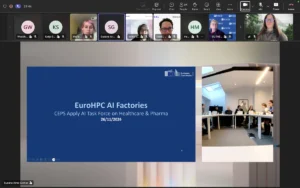
The session examined two of the key challenges repeatedly identified during the summit:
- The infrastructure needed to scale AI adoption
- The development of a robust AI assurance ecosystem for healthcare and pharma.
Discussions addressed access to compute resources, European AI Factories and AI Gigafactories, EHDS-enabled health data infrastructures, local validation environments, AI assurance mechanisms and the evidence required to establish trustworthiness in real-world clinical settings.
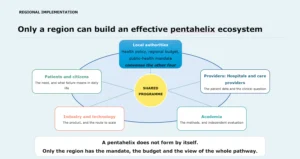
Another key topic that emerged during the CEPS Apply AI Task Force discussion was the importance of regional implementation ecosystems. Several participants argued that successful healthcare AI adoption requires more than technology providers and research organisations. Sustainable deployment depends on the coordinated involvement of health authorities, care providers, industry, academia and citizens, each contributing different capabilities, perspectives and requirements. This reflects the growing recognition that while European initiatives can support research, testing and capacity building, many of the practical enablers of AI adoption, including infrastructure, procurement, governance and operational integration, are often best addressed at regional or national level.
One of the central concepts discussed is the development of an AI assurance ecosystem combining testing, evaluation, monitoring and trust-building mechanisms across the entire AI lifecycle. The framework recognises that successful AI adoption requires not only regulatory compliance but also evidence of clinical benefit, robust infrastructure, local validation and continuous oversight.
Five strategic takeaways for business leaders
The Apply AI Summit 2026 highlighted five signals that organisations should consider when defining their AI strategies:
1. Deployment speed is becoming the key competitive variable
The challenge is no longer acquiring access to AI models. The winners will be organisations capable of translating capability into production faster and more effectively.
2. Trustworthy AI is moving from compliance requirement to business differentiator
Governance, transparency and accountability are becoming factors that directly influence market adoption.
3. Sector-specific governance is accelerating
Healthcare, mobility, cybersecurity and public services are developing increasingly specialised governance and risk-management expectations.
4. Skills remain one of the largest barriers to adoption
Many organisations face greater limitations from workforce readiness than from technology availability.
5. AI Safety is becoming a board-level topic
As AI systems become more autonomous, safety, evaluation and oversight are moving from technical discussions into strategic decision-making.
Our perspective
At Mosaic Factor, the discussions held in Brussels strongly reinforce what we are seeing across European innovation ecosystems and Horizon Europe projects. The future of AI adoption will not be determined solely by model accuracy or computational performance. It will depend on organisations’ ability to build safe, explainable and trustworthy AI systems that can operate confidently within complex real-world environments.
The convergence of AI Safety, Explainable AI (XAI), governance, AI assurance and regulatory readiness is shaping the next generation of AI solutions, particularly in sectors such as healthcare, where trust is a prerequisite for adoption.
The Apply AI Summit 2026 demonstrated that Europe has entered a new phase of AI maturity. The conversation is no longer about whether AI will transform industries. It is about how quickly organisations can deploy it responsibly, safely and at scale.
→ Check our Trustworthy AI solution